
The price of a flight to Corsica is not simply a matter of classic supply and demand. Several structural mechanisms, rarely detailed, explain why a round trip from Paris to Ajaccio can exceed the fare of a transatlantic flight during peak season. Here, we break down the technical factors and concrete levers to reduce the bill.
Airport fees and taxation: the invisible cost of flights to Corsica
The four Corsican airports (Ajaccio, Bastia, Figari, Calvi) apply passenger fees and boarding taxes that significantly impact the final ticket price. These fees fund the operation of infrastructures designed to handle a summer peak but are underutilized for the rest of the year.
The fixed cost per passenger is therefore mechanically higher than at a continental hub with high annual traffic. For comparison, an airport like Marseille or Lyon amortizes its charges over a regular flow, whereas Corsican airports concentrate most of their activity over four months.
Recent regulatory debates in Corsica specifically address the taxation related to air and maritime transport. The issue of boarding taxes and their potential modulation is the subject of public discussions, indicating that the problem is recognized by institutions without a structural solution yet adopted.
Before even trying to find a direct flight to Corsica at the best price, we recommend understanding this reality: a significant portion of the fare is completely outside the commercial policy of the airlines.
Oligopoly of airlines on Corsican routes
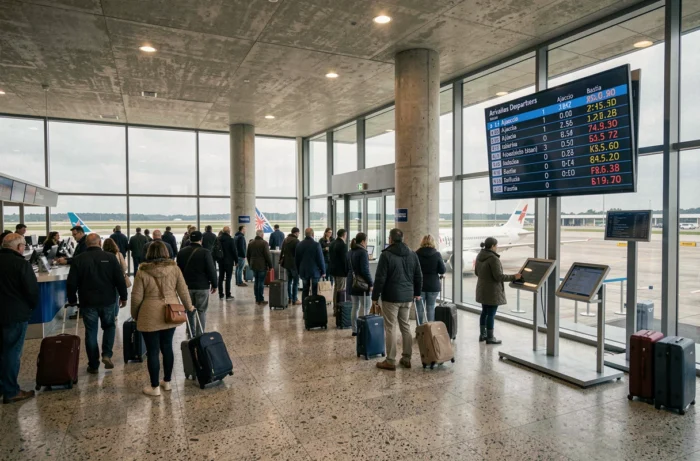
The air market to Corsica operates in a restricted oligopoly. Air Corsica and Air France share most of the connections from the mainland, with limited competition on certain routes. Low-cost airlines operate occasionally, but their flights remain concentrated during the high season and on specific routes.
Less competition means less downward pressure on prices. On a route like Paris-Ajaccio, the number of operators is not enough to create a price war comparable to what exists on Paris-Barcelona or Paris-Rome, where five to eight airlines compete for passengers.
The air supply to Corsica continues to increase, but this rise in capacity does not automatically guarantee low prices. The load factor remains the true indicator: airlines adjust their prices in real-time through yield management, and a plane filled to 90% in July has no reason to lower its prices.
Extreme seasonality: the real driver of price surges
The seasonality of flights to Corsica is much more pronounced than on most French destinations. Demand explodes between June and September, then drops sharply. This imbalance has direct consequences on the pricing structure.
- In high season, airlines maximize their revenue per seat. Yield management raises prices as occupancy increases, sometimes dramatically in the final weeks before departure.
- Off-season, prices drop significantly on several routes, but frequencies also decrease, reducing flexibility for travelers.
- The Collectivité de Corse has implemented a financing system aimed at attracting 250,000 tourists per year off-season, proving that the problem is not just the cost but also filling planes during low periods.
This off-season incentive mechanism is a clear signal. It confirms that traveling to Corsica between October and May remains the most effective lever for obtaining a reasonable fare.
Public service obligation and territorial continuity
The so-called public service (DSP) connections between the mainland and Corsica benefit from subsidies that cap fares for Corsican residents. These regulated fares do not apply in the same way to non-residents, who pay the commercial fare.
We regularly observe confusion on this point. The DSP does not mean that all tickets are subsidized. A non-resident traveler booking a flight in July on a DSP route pays a market price, albeit regulated, but often high due to demand.
Reducing the price of a flight to Corsica: effective strategies
Some concrete approaches can help limit expenses, provided you take a methodical approach.
- Book directly on the airline’s website. Comparators sometimes add fees or display non-guaranteed fares. Air Corsica, Air France, and low-cost airlines offer their best prices directly.
- Prefer provincial airports. A flight from Marseille to Bastia or Nantes to Ajaccio often costs less than a departure from Paris, with less competition on the slot and therefore different pricing policies.
- Aim for shoulder seasons (May, June, September). Prices are significantly lower than in July-August, and frequencies remain sufficient for choice.
- Monitor Flex and Super Flex offers. Operators like Corsica Linea (on maritime routes) offer flexible rates depending on cancellation conditions. This segmentation also exists on the air side, and the cheapest ticket is not always the most relevant if your schedule may change.
Anticipate without booking too early
Booking very far in advance (six months or more) is not always suitable for Corsica. Airlines publish their flight plans late on certain routes, and a flight booked too early may be changed or canceled. We recommend monitoring sales openings, generally between January and March for summer, then comparing two to three weeks before confirming.
The classic trap is to rush for the first displayed fare out of fear of a price increase. On Corsican routes, prices do not rise linearly: they can temporarily drop mid-week or during flash promotions, before rising again as departure approaches.
The cost of a flight to Corsica results from a stack of structural constraints (insularity, airport taxation, oligopoly) over which the traveler has no control. The leeway lies in the choice of the period, the departure airport, and the booking channel. Three variables that, combined, can vary the fare from simple to triple.