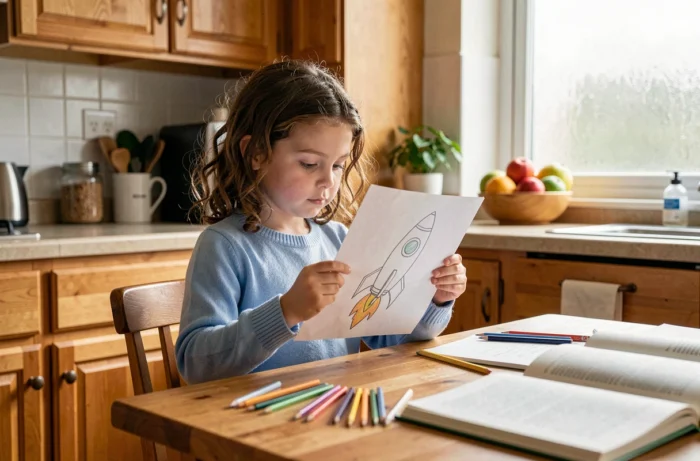
A child drawing a rocket on a white sheet of paper or stating they want to become a veterinarian expresses a form of projection into the future. This ability to envision a possible future mobilizes cognitive and emotional skills that develop gradually, well before entering middle school. Supporting these projections, even if vague, helps to structure self-confidence and long-term academic motivation.
Self-projection and cognitive development in young children
Before discussing orientation or pathways, one concept deserves to be established: self-projection. In developmental psychology, this term refers to an individual’s ability to envision themselves in a future situation, whether realistic or imaginary. In children, this ability gradually emerges between the ages of three and six, when language and symbolic thinking become sufficiently developed to formulate scenarios.
At this age, saying “when I grow up, I will be a firefighter” is not a career choice. It is a mental exercise that combines memory, imagination, and a rudimentary understanding of the adult world. The child is testing social roles, not job descriptions.
The role of parents and educators at this stage is to welcome these projections without correcting or overvaluing them. A response that takes the dream seriously (“What would you do as a firefighter?”) nurtures reflection. A dismissive response (“It’s too hard, choose something else”) hinders exploratory momentum. Resources like quandjeseraigrande.net help families find suitable supports to extend these conversations with children.

Childhood dreams and academic orientation: not to confuse timelines
A common trap is to treat the aspirations of a five-year-old with the tools of academic orientation for a teenager. Childhood dreams are not professional projects, and mixing them produces two negative effects.
The first: early pressure that associates daydreaming with performance. The child understands that their desire must “lead somewhere,” which reduces their freedom to explore. The second: a programmed disappointment when the initial dream does not match the realities of the academic journey.
The operational distinction is as follows. Between the ages of three and eight, support focuses on openness: multiplying experiences (visits, readings, encounters with various professions), encouraging curiosity without filtering for feasibility. Between nine and twelve years old, a more concrete dimension can be added: identifying what the child enjoys doing (building, storytelling, caring, solving), without yet linking it to a specific training.
Structured academic orientation, with its choices of pathways and training, comes into play during adolescence. But it works better when the child has had, for years, the freedom to dream broadly.
Mental health and the ability to project oneself in young people
An often-overlooked angle in discussions about supporting children: a child who is struggling has difficulty projecting themselves. Anxiety, academic stress, or dropping out reduce the self-projection capacity mentioned earlier. The future becomes blurry or threatening instead of being a space for exploration.
The rise of listening services for young people in France reflects this reality. Lines like Fil santé jeunes, mentioned by Le Figaro in September 2026, serve as a sentinel to identify adolescents whose distress blocks any form of future project.
Specifically, supporting a child in their dreams also means being attentive to their emotional state. A few signals deserve parents’ attention:
- A child who suddenly stops talking about what they want to do “later,” when they used to do so regularly, may be expressing emotional withdrawal
- A teenager who systematically rejects any discussion about their future with hostility (and not just indifference) sometimes signals anxiety related to academic performance
- A loss of interest in extracurricular activities that fueled their projects (sports, drawing, music) may indicate exhaustion or deeper distress
In these situations, the challenge is no longer to stimulate projection, but to first restore a sense of security.
Role of parents in the exploration of careers
Parents remain the primary mediators between the child and the professional world. But this mediation works better when it takes the form of diverse exposure rather than directional guidance.
Exposing a child to various professions does not mean organizing internships in kindergarten. It involves simple gestures: explaining what the adults they encounter daily do, reading books that describe concrete professional activities, visiting workplaces when the opportunity arises.
The most productive parental posture is to ask questions rather than provide answers. “What do you like about this job?” helps the child identify their own criteria for choice. “You should go into medicine” projects the parent’s aspirations onto the child.
What changes in adolescence
As the child approaches middle school, conversations benefit from incorporating concrete elements: what training exists, how long studies last, what a workday looks like in a particular field. The teenager needs reliable information, not motivational speeches.
Academic orientation choices come quickly, and young people who have been used to reflecting on their desires, even informally, approach these deadlines with more perspective. The exploration journey undertaken since childhood does not guarantee a perfect choice, but it reduces the feeling of being subjected to an externally imposed decision.
Supporting childhood dreams does not require a structured program or a dedicated budget. It relies on regular attention to what the child expresses, openness to professions and training that go beyond the family framework, and vigilance regarding emotional well-being, which conditions any ability to imagine tomorrow.