The long bob on a mature 90-year-old hair poses a specific technical problem: the fiber, thinned and often porous, can no longer hold its length without sagging on the sides of the face. Shortening does not mean sacrificing shape, but redistributing volume where hair density still allows. Transitioning to a well-calibrated short cut relies on reading the hair, not on a trend.
Hair Diagnosis Before Cutting: Density, Texture, and Placement
We systematically recommend a diagnosis of the scalp and fiber before any transition. On a 90-year-old’s hair, the density per square centimeter has significantly decreased compared to hair of a 60 or 70-year-old. The temporal areas and crown are the first affected.
Placement is as important as density. A pronounced frontal cowlick points towards an asymmetrical pixie. A low placement at the nape allows for retaining a few centimeters of length at the back without weighing down the silhouette.
The texture of white hair, often coarser and less supple than pigmented hair, reacts differently to cutting. Fine, straight hair will not support the same layers as wavy hair that is still relatively thick. The stylist must adapt the cutting angle to this reality, not to a magazine photo.
The transition to a short hairstyle for 90-year-old women is best thought of as a protocol over two or three visits rather than a single radical cut. First, shorten the nape, retain the length in front, evaluate the result before finalizing the shape: this gradual approach significantly reduces the risk of regret.

Textured Short Cuts for Fine Hair After 90
The reflex of “very short uniform” is a technical mistake. Textured cuts compensate for the loss of density much better than a shaved or ultra-short homogeneous cut that exposes the scalp.
The Textured Pixie-Bob
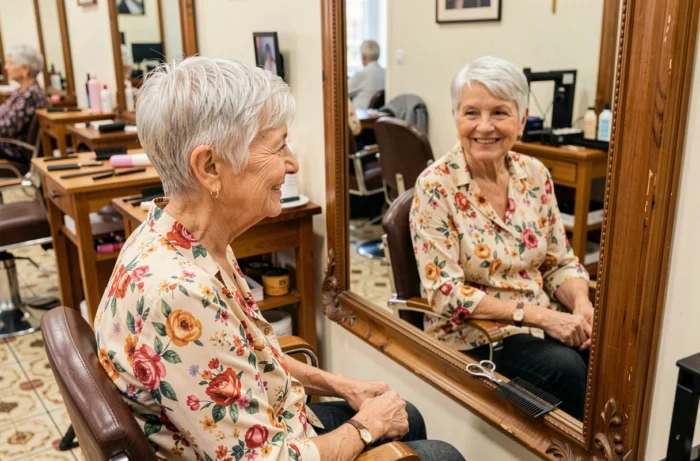
The cropped pixie-bob retains volume on top of the head thanks to short layered cuts. The nape remains clean, with the sides slightly tapered. This style works particularly well on wavy white hair, as the natural texture creates movement without blow-drying.
The Long Pixie with Side Bangs
For women used to a long bob, the long pixie represents a convincing compromise. The length in front reaches the cheekbone, and the bangs sweep across the forehead without hiding the eyes. This gradual layering softens the oval of the face while removing the weight that was pulling the hair down.
Three technical criteria guide the choice of cut:
- The dexterity of the person on a daily basis: a cut that requires a dryer and a round brush every morning is unsuitable if arm or shoulder mobility is reduced.
- The rate of regrowth and frequency of salon visits: a very structured pixie requires maintenance every four to five weeks, while a textured pixie-bob remains presentable longer.
- The shape of the skull: a flat skull at the back requires volume at the crown, while a round skull can support more fitted cuts on the sides.
Managing the Transition to Gray and Regrowth on Short Cuts
When the long bob was still colored, the gray regrowth band created a visible contrast within three weeks. Shortening the cut mechanically reduces the demarcation area between colored hair and natural regrowth.
We observe that the majority of 90-year-old women transitioning to short hair abandon coloring in the process. The short cut makes the grow-out much more discreet: the intermediate phase lasts a few weeks instead of several months.
For those who wish to maintain a slight tone, a translucent gloss or a violet pigmented shampoo is enough to neutralize the yellowing of white hair without heavy maintenance. This avoids salon visits dedicated solely to color.
Minimal Styling Suitable for Reduced Mobility
The most underestimated criterion in choosing a short cut after 90 is not aesthetic: it’s the daily gesture. Raising arms above the head, handling a hairdryer, holding a round brush, all become difficult in cases of cervical osteoarthritis or stiff shoulders.
Wash-and-wear cuts eliminate the need for blow-drying styling. After shampooing, simply towel dry and reposition the strands by hand. Textured white hair naturally takes its shape if the cut has been done respecting the growth direction.
Some practical adjustments to discuss with the stylist:
- Favor thinning that falls into place without intervention rather than a very structured layering that requires styling.
- Avoid thick straight bangs that stick to the forehead without blow-drying and require daily maintenance.
- Ensure sufficient length on top so that the cut remains flattering even without styling, typically five to eight centimeters.
Hair Care After the Cut: Adapting the Routine to Short White Hair
The transition to short hair changes the care routine. A three-centimeter hair does not require the same conditioner as a long bob. Too much product weighs down the cut and clumps the strands together.
A gentle sulfate-free shampoo, used two to three times a week, is enough to maintain cleanliness without drying out the fiber. White hair needs hydration, not artificial volume. Light texturizing sprays work better than styling mousses on this type of hair.
The scalp also deserves attention. At 90, the skin on the scalp is thinner and more sensitive. A gentle massage during shampooing stimulates microcirculation without aggression. Products with high alcohol concentration should be avoided.
Regret after a short cut rarely comes from the lost length. It comes from a cut that is unsuitable for the actual texture of the hair, or from styling that is too demanding relative to daily mobility. When these two parameters are correctly assessed in advance, the transition from long bob to short is made without looking back.