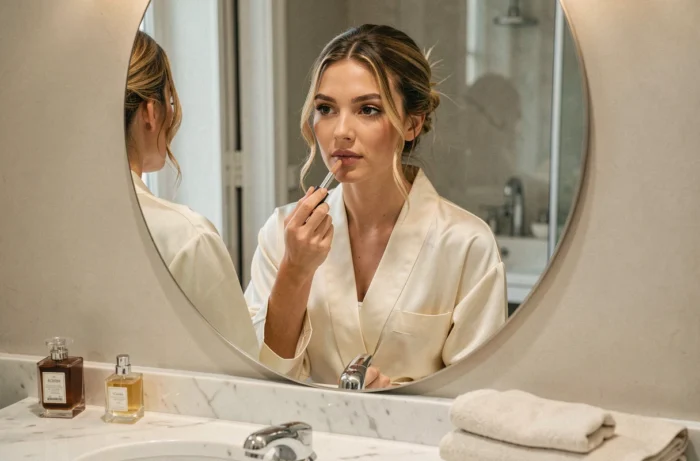
A beauty trend is not just about a filter on social media. Behind the routines circulating online, European regulatory changes and reformulations of active ingredients are significantly altering what is contained in skincare and makeup products available on the shelves. Understanding these developments allows for more informed choices in daily life, whether the priority is facial care, makeup, or fragrance.
Restrictions on retinol: what changes in anti-aging care
Retinol and its derivatives (retinyl acetate, retinyl palmitate) are among the most sought-after actives in anti-aging creams. Their ability to stimulate cell renewal has made them a staple in facial care routines for years.
However, Europe has introduced specific regulatory limits on vitamin A derivatives, with thresholds varying according to product category. According to Oxford Biosciences, compliance runs until 2027 for certain products already on the market. In practice, formulations will evolve: high concentrations of retinol in serums and night creams will be capped.
To adapt your routine, it is essential to monitor the INCI lists on packaging. Brands that reformulate do not always clearly indicate this, and a familiar product may change composition from one batch to another. Those looking for useful information on Mes Secrets de Beauté will find guidelines to track these product evolutions on a product-by-product basis.
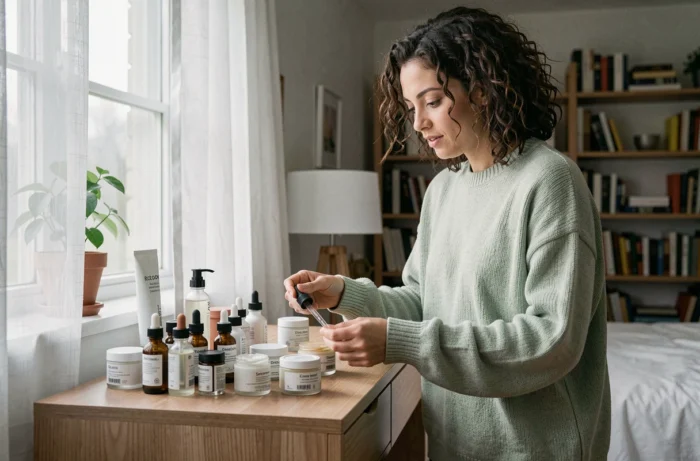
Makeup and beauty tips: foundation goes minimalist
Skinimalism, a contraction of “skin” and “minimalism,” refers to an approach to makeup that reduces the number of products applied to the skin. The goal: a natural finish, with fewer layers stacked.
In practice, this translates to a light foundation or a tinted cream combined with a moisturizing treatment. Mascara remains a staple of the daily look, but textures are evolving towards formulas that coat without weighing down. Ultra-pigmented full-coverage foundations are giving way to buildable formulas.
Three concrete steps to lighten your makeup routine
- Replace classic foundation with a tinted cream with SPF, which combines sun protection and color correction in one step.
- Apply mascara in a single thin layer on previously curled lashes, which gives a cleaner result than a double application on straight lashes.
- Use a multi-use tinted balm (lips, cheeks, eyelids) to limit the number of products without sacrificing color.
This approach may not suit all occasions, but reducing your daily product range simplifies the routine without compromising the result.
Cosmetic packaging: the PPWR regulation and its effects on beauty products
The European regulation PPWR (Packaging and Packaging Waste Regulation) now imposes harmonized requirements on reducing packaging, eco-design, recyclability, and recycled content. Cosmetic brands are directly affected.
Oxford Biosciences notes that this framework pushes manufacturers to reformulate both their packaging and their formulas. Perfume bottles, cream tubes, and makeup palettes must incorporate a minimum percentage of recycled materials. Decorative over-packaging, common in the high-end fragrance segment, is also under scrutiny.
For consumers, this means packaging that changes appearance (less shiny materials, more frequent refillable formats) without necessarily altering the quality of the product inside.
Microplastics and natural cosmetics
The phased ban on microplastics in cosmetics, reported by Personal Care Insights, forces brands to find alternatives for exfoliating textures, suspension agents, and certain film-forming agents. Products labeled “clean beauty” or “natural” are not automatically compliant: a product labeled natural can still contain synthetic polymers as long as the regulation is not fully enforced.
The useful reflex remains to check for ingredients like acrylates copolymer or polyethylene in the INCI list, even on products that claim a natural positioning.
Fragrance and hair care: trends changing habits
Fragrance remains one of the most personal beauty segments, but purchasing habits are evolving. The trend of “layering” (overlapping fragrances) is gaining ground: applying a neutral base (scented dry oil or balm) followed by a fragrance allows for modulation of intensity and longevity throughout the day.
In hair care, hybrid products that combine scalp treatment and styling are progressing. The idea is to treat the hair from the wash rather than multiplying steps like conditioner, mask, serum. Concentrated formulas with actives (proteins, ceramides) integrated directly into the shampoo or conditioner allow for a shorter routine without sacrificing effectiveness.
- A well-formulated treatment shampoo often replaces a weekly mask for fine to normal hair.
- Dual-function styling serums (smoothing and nourishing) reduce daily styling time.
- Scented hair mists offer an alternative to classic perfume, less aggressive for the hair fiber than the concentrated alcohol in an eau de toilette.
Ongoing European regulations do not only affect facial products. Hair products containing certain preservatives or UV filters are also under revision, which will lead to reformulations in the coming months. Adapting your beauty routine today also means anticipating the composition changes that will hit the shelves by 2027.