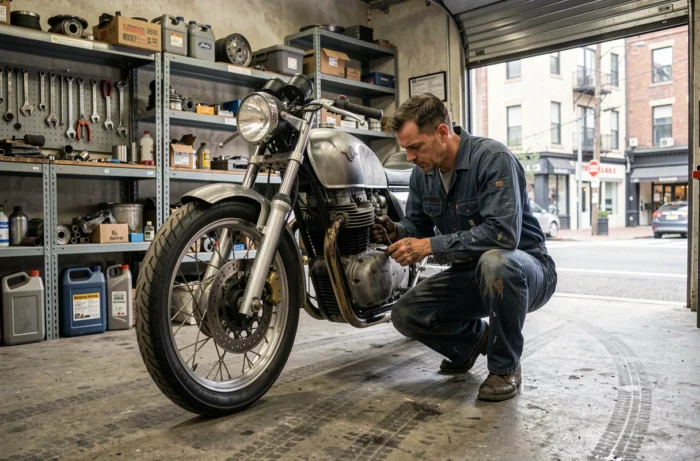
Buying a motorcycle involves much more than just a crush in front of a shop window. The choice of model depends on your license, your size, the intended use, and a recent parameter that many guides overlook: the technical inspection, which has become mandatory for two-wheelers since April 2024.
Motorcycle Technical Inspection: What Changes for Purchase in 2026
Since April 15, 2024, all category L vehicles subject to registration must undergo a periodic technical inspection. Motorcycles, scooters, tricycles, and quads are affected.
The rollout follows a progressive schedule. Vehicles registered before January 1, 2017, must be inspected by the end of 2024. Those put into circulation between 2017 and 2019 will be inspected in 2025. Motorcycles registered between 2020 and 2021 will be affected in 2026.
After the first inspection, the standard periodicity is three years. For a buyer, this means a recurring cost to integrate into the overall budget, just like insurance or regular maintenance.
Are you looking for a used motorcycle? Make sure the seller provides a technical inspection less than six months old in the sales file. Without this document, the transaction cannot be finalized for a two-wheeler older than five years. This point changes the game compared to habits before 2024.
To compare the characteristics of a model before you go, you can check the technical sheets and motorcycle information that detail displacement, power, and dimensions by reference.

Roadster, Trail, or Sportbike: Understanding Motorcycle Categories
Have you ever noticed that two motorcycles of the same displacement can offer radically different sensations? The category of the model explains everything.
Roadster: Everyday Versatility
A roadster is a motorcycle without fairings, with a relatively high handlebar and an upright riding position. In the city as well as on the road, this posture limits fatigue. Honda, Yamaha, and Kawasaki offer roadsters accessible from the A2 license.
The roadster suits the majority of daily uses. Commuting, weekend rides, first kilometers after getting your license: it forgives riding mistakes thanks to a low center of gravity and a manageable weight.
Trail: The Road and a Bit More
The trail is recognized by its long-travel suspension and high position. It rides very well on the road but can also handle rough paths. For traveling or varied routes, it’s a logical choice.
Be careful about seat height. On a trail, it often exceeds standard heights, which can be problematic if your inseam is short. Always try before you buy.
Sportbike: A Very Specific Use
The sportbike positions the torso forward, with low wrists and bent knees. In the city or on long trips, this position quickly becomes uncomfortable. It makes sense on a track or winding roads, where aerodynamics and power really matter.
For a first motorcycle, the sportbike is rarely the best choice. The riding position masks speed sensations, which can mislead an inexperienced rider.
Motorcycle License and Power: What the Regulations Allow
The license directly conditions the models you have access to. There are three levels:
- The A1 license (available from 16 years old) limits displacement to 125 cm3 and power to 11 kW. It opens access to small roadsters and urban scooters.
- The A2 license (from 18 years old) allows motorcycles up to 35 kW. Most manufacturers offer restricted versions of their models to fit within this limit.
- The A license (after two years of A2 and additional training) grants access to all motorcycles, with no power restrictions.
Why does this detail matter so much? Because a buyer with an A2 license who chooses a restricted motorcycle must check that future derestriction is possible and approved. Not all restricted motorcycles can be derestricted under the same conditions, and the cost of the operation varies by model.
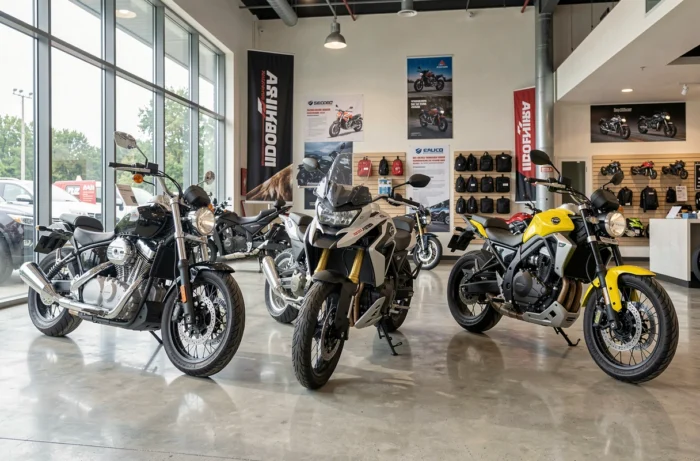
New or Used Motorcycle: The Real Criteria for Choice
The purchase price is just one part of the equation. Here’s what really tips the balance.
A new motorcycle guarantees the latest safety equipment (latest generation ABS, traction control). It comes with a manufacturer’s warranty and requires no verification of maintenance history.
A used motorcycle costs significantly less, but requires concrete checks before signing:
- Valid technical inspection less than six months old (mandatory for motorcycles older than five years)
- Absence of non-approved technical modifications (exhaust, engine reprogramming)
- Condition of consumables: tires, brake pads, chain, and transmission kit
- Maintained service history, ideally with invoices from the dealer or mechanic
A good reflex: ask for the maintenance book even before seeing the motorcycle. If the seller cannot provide it, it’s a serious red flag.
Overall Motorcycle Budget: Often Underestimated Costs
The catalog price does not reflect the true cost of ownership. Several factors increase the bill from the first year.
The rider’s gear represents a significant investment. Approved helmet, CE-certified gloves (mandatory), jacket with back and elbow protections, high boots: the complete gear for a motorcyclist often costs as much as an annual maintenance.
Motorcycle insurance varies greatly depending on your experience, age, and the chosen model. A young rider on a sportbike will pay a much higher premium than an experienced motorcyclist on a mid-displacement roadster.
The technical inspection, now mandatory every three years, adds an additional budget item. Its cost remains moderate compared to mechanical maintenance, but it must be anticipated in the schedule.
Regular maintenance (oil changes, filters, tires, chain) depends on mileage and type of motorcycle. A trail used on paths will wear its tires out faster than a roadster confined to asphalt.
Taking the time to estimate these costs before purchase avoids unpleasant surprises. A motorcycle that is affordable to buy but expensive to maintain can quickly exceed the budget of a more expensive model that is more economical in consumables.