
The viscosity and tackiness of a chain oil directly determine the longevity of the guide, links, and drive sprocket. Switching to a vegetable or biodegradable formulation is not just about pouring canola into the tank: choosing an eco-friendly lubricant involves specific technical parameters, and soon a much stricter European regulatory framework.
EmpCo Directive and biodegradable chain oil: what changes in September 2026
The European directive Empowering Consumers for the Green Transition (EU) 2024/825, known as EmpCo, comes into effect on September 27, 2026. From that date, the terms “eco-friendly,” “green,” or “climate-friendly” without a recognized label will become illegal on consumer lubricants, including chain oils.
In practical terms, a manufacturer displaying “bio chain oil” on their container will need to rely on a certification such as the EU Ecolabel or an ISO 14024 Type I label. Claims of carbon neutrality based solely on compensation will also be prohibited.
For the professional user, the consequence is direct: current product lines will be reformulated or withdrawn. We recommend checking now if the product being used carries a compliant label and being wary of end-of-life stock sold at reduced prices before the regulatory deadline. By exploring alternatives to chainsaw chain oil, we find that few references already display this compliance.
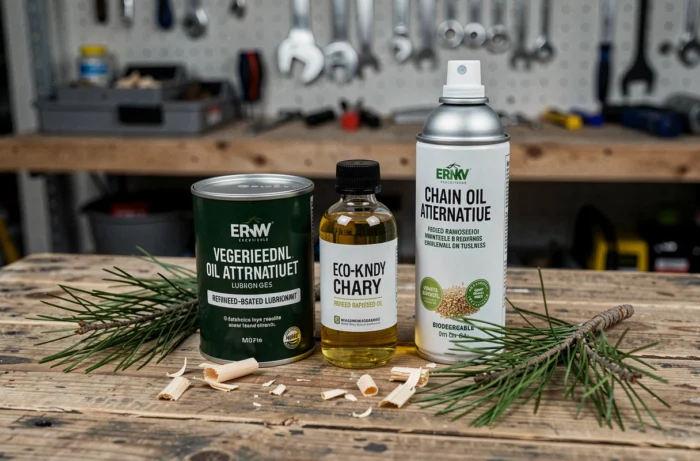
Vegetable oils for chainsaws: viscosity, tackifiers, and real limits
The most common vegetable bases in chain lubrication are canola, sunflower, and, to a lesser extent, castor oil. Their main advantage lies in their rapid biodegradability and low toxicity to soils and waterways.
Their technical limit is not anecdotal. A raw vegetable oil lacks tackiness at high chain speeds, which causes excessive splatter and insufficient lubrication of the guide nose. The oil film breaks down faster than with an additive-enhanced mineral base.
The role of tackifier in performance
To compensate for this deficit, professional biodegradable formulations incorporate a tackifier (slip agent) that increases resistance to centrifugal force. Without this additive, oil consumption rises significantly and guide wear accelerates.
We observe that vegetable oils from large food retailers (cooking canola, budget sunflower) contain no tackifier. Using them as a backup is possible for a few cuts, but prolonged use without an adhesion additive degrades the guide and chain.
- Additive canola (tackifier + antioxidant): stable viscosity profile, suitable for regular use in felling or pruning.
- Raw sunflower: viscosity too low when hot, acceptable only for occasional backup on softwood.
- Castor: excellent natural tackiness, but high cost and limited availability in suitable packaging.
Additives and storage stability: the pitfalls of biodegradable oils
A vegetable lubricant ages faster than a mineral base. Oxidation transforms the oil into a sticky residue that clogs the lubrication circuit, the suction filter, and the guide groove.
The storage life of a vegetable chain oil rarely exceeds twelve to eighteen months once the container is opened, compared to several years for a mineral oil. This parameter is often overlooked by occasional users who buy a container for an entire season, or even two.
Antioxidants and protection against polymerization
Quality formulations incorporate antioxidants (tocopherols, TBHQ) to delay degradation. Checking for the presence of these additives on the product’s technical data sheet helps avoid premature clogging.
In practice, we recommend storing the container away from light and below 25 °C, and purging the chainsaw’s tank if the tool remains unused for more than four weeks.

Criteria for selecting a reliable eco-friendly chain oil
The market offers dozens of references labeled “organic” or “biodegradable.” To effectively filter them, four technical criteria allow for the exclusion of unsuitable products:
- Presence of a EU Ecolabel or ISO 14024 Type I certification, the only enforceable guarantee after the EmpCo directive comes into effect.
- Explicit mention of a tackifier (adhesion agent) in the formulation, essential for limiting splatter and wear.
- Viscosity indicated on the technical data sheet: a grade suitable for the working temperature range (an oil that is too fluid when hot does not protect, an oil that is too thick when cold does not circulate).
- Clearly displayed expiration date or shelf life after opening, to avoid the oxidation issues mentioned above.
Recycled mineral oils, sometimes presented as “eco-friendly alternatives,” pose a composition problem: they may contain residues of heavy hydrocarbons and generally do not meet the rapid biodegradability criteria required by environmental labels.
Chain maintenance and vegetable lubrication: adapting habits
Switching to a biodegradable oil requires adjusting the lubrication flow rate. With a vegetable base, even when additive-enhanced, the flow rate of the automatic oiler often needs to be increased by one notch to compensate for slightly lower tackiness compared to a high-end mineral oil.
Cleaning the guide also deserves increased attention. Oxidized vegetable residues clog the lubrication groove more quickly. Cleaning the guide groove at each chain sharpening prevents accumulation.
The guide-chain-sprocket assembly forms a coherent tribological system. Changing only the oil without monitoring chain tension, the condition of the sprocket, and the wear of the links is akin to treating a symptom without considering the complete circuit. A high-performing vegetable lubricant, combined with rigorous maintenance, offers protection comparable to that of a conventional mineral oil, with a significantly reduced environmental impact on forest soils and groundwater.