The Tinetti test is a clinical observation tool designed in 1986 to assess balance and gait in elderly individuals. Its PDF version circulates in various forms in French nursing homes, often without mentioning the methodological limitations highlighted by recent research. This gap between common usage and available data deserves to be examined before downloading and printing a grid.
Reliability of the Tinetti score: what PDF grids do not specify
The PDF forms found online present the Tinetti test as a score out of 28 points, divided between a balance section (16 points over 9 items) and a gait section (12 points over 7 items). The administration takes about five minutes, making it a favored tool among care teams in nursing homes for its speed.
The problem lies elsewhere. No balance test taken in isolation predicts future falls, including the Tinetti. A systematic review focused on prospective falls concludes that its role should be limited to identifying and monitoring balance disorders, never to stratifying fall risk on its own. Teams that use a PDF grid to assign a “risk level” based on the raw score go beyond what the tool can guarantee.
Another point rarely mentioned in printable documents: a change of at least 5 points is necessary at the individual level to consider that a true clinical change has occurred in a resident. Below this threshold, the variation may be due to measurement noise. For group monitoring (cohort of residents), a difference of 0.8 points is sufficient to detect an evolution, but this distinction does not appear on any common PDF grid.
Care teams wishing to have a printable Tinetti test PDF would benefit from accompanying the document with a note reminding these interpretation thresholds, rather than relying on the raw score without context.

Tinetti test cut-off points: a false consensus
Most PDF grids and educational pages propose a single threshold to define a high fall risk, often set at 19 or 20 out of 28. This figure circulates as an obvious fact, but the cut-off points vary according to studies and lack robust consensus.
A recent review highlights this heterogeneity. The thresholds used depend on the population studied (people living at home, institutional residents, hospitalized patients), inclusion criteria, and follow-up duration. Transposing a threshold from a community study to a nursing home protocol poses a methodological problem that PDF documents do not address.
In practical terms, a resident scoring 21 out of 28 may be classified as “moderate risk” according to one grid and “low risk” according to another. This variability does not invalidate the test, but it imposes the necessity of not basing a care decision on an isolated score.
What a nursing home protocol should integrate
- The Tinetti score as one element among others in a comprehensive geriatric assessment, and not as an autonomous verdict
- The explicit mention of the clinically significant change threshold (5 points in individual follow-up) on the printed document
- A systematic cross-reference with daily observations by caregivers, fall history, and ongoing treatments (notably psychotropics and antihypertensives)
Variants of the Tinetti score: 28 or 35 points depending on the version
A technical detail complicates comparisons between establishments. Two versions of the test coexist in French nursing homes, with different scoring systems.
The original version by Mary Tinetti (1986) totals 28 points distributed over 16 items. The so-called “modified” version, used by some establishments and online simulators, includes 22 items for a total score of 35 (26 for balance, 9 for gait). In this second version, the scoring logic is reversed: the higher the score, the greater the fall risk.
This coexistence creates real confusion. A score of 20 out of 28 (original version) corresponds to a moderate risk. A score of 20 out of 35 (modified version) may indicate a very different profile. Checking the version used before interpreting a score is a minimal precaution that PDF grids almost always omit.
Printing the Tinetti test: practical elements for teams
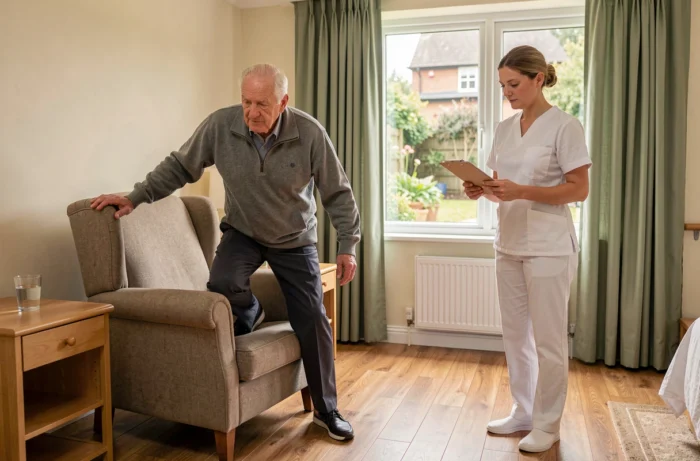
The test requires simple equipment: a chair with a backrest and no armrests, and a clear corridor of about five meters. The evaluator observes the patient performing a sequence of standardized movements.
Administration process
The first part assesses static balance: stability in a sitting position, getting up from the chair, standing balance with eyes open then closed, resistance to a sternum push, pivoting in place. The second part focuses on gait: initiation of steps, length and height of the foot, symmetry, continuity, trajectory, and trunk stability.
Each item is scored from 0 to 1 or from 0 to 2 depending on the version. The evaluator does not need specialized training, but careful reading of the scoring criteria before the first administration reduces inter-evaluator discrepancies.
- Print the grid in A4 format, one side only, to facilitate annotation at the resident’s bedside
- Record the score in the care file with the date, evaluator’s name, and the version of the test used (28 or 35 points)
- Plan for a re-evaluation at regular intervals (after a fall, a change in treatment, or a prolonged period of bed rest)
The Tinetti test remains a useful screening tool in nursing homes, provided that it is not asked to provide what it cannot deliver. A raw score without clinical context does not guide either prevention or management. Teams that print the PDF grid should consider adding, even in the margins, the thresholds for significant change and the version of the scoring system used.