
A site whose structure does not reflect Google’s crawl logic loses visibility even before the quality of the content comes into play. Organizing a website’s content with a clear plan is primarily about creating a structure that search engines can interpret unambiguously and that visitors can navigate without friction.
Sitewide signals and structural consistency: what the integrated Helpful Content changes
Since March 2024, the Helpful Content system is no longer a one-time update. It functions as a continuously integrated signal in every core update, with a sitewide effect. A poorly structured or orphaned section no longer only penalizes its own URL: it drags down the overall evaluation of the domain.
We observe that sites that have recovered after a traffic loss related to Helpful Content have all followed the same approach. They did not simply add fresh content. They reviewed the entire structure to remove or merge redundant pages and focused the structure on areas where the site has real legitimacy.
The method that works is based on a segmentation into three categories: high-value pages (unique content, active organic traffic), pages to rebuild (thematic potential but weak execution), and pages to delete or set to noindex. This sorting, cross-referenced with Search Console data over twelve to eighteen months, provides a structure plan based on evidence rather than editorial intuition.
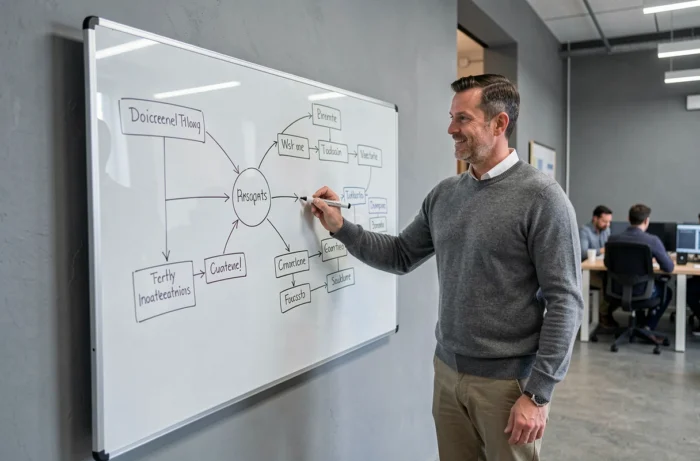
A concrete example of this logic applied to an online health site: the sitemap of neo-sante.fr makes the complete hierarchy of sections readable and allows verification that no page floats outside the structure.
Website structure and click depth: the technical thresholds
No strategic page should be more than three clicks away from the homepage. This principle is not a vague recommendation: it directly conditions the crawl frequency. The deeper a page is in the structure, the less crawl budget it receives, and the more its indexing becomes random.
We recommend mapping the actual depth before touching the content. Several crawlers (Screaming Frog, Sitebulb) allow you to visualize the number of levels and identify buried pages. The sitemap should then reflect this hierarchy.
Structuring categories by search intent
Organizing sections by business theme is a common mistake. A performing structure groups pages by user search intent, not by the company’s internal organizational chart.
- Transactional pages (services, products, forms) form the first silo, linked to the main navigation.
- Informational pages (guides, blog articles) constitute a second silo, with internal links to the corresponding transactional pages.
- Proof pages (testimonials, certifications, author pages) reinforce E-E-A-T signals and connect to the previous two silos through contextual links.
This user-oriented silo architecture facilitates search engines’ work in understanding the thematic relevance of each section.
Author pages and E-E-A-T: an underutilized structural lever
Google increasingly values content attributable to an identifiable person or organization, via structured data for Person and Organization. How you organize “About” pages, author biographies, and proof of experience becomes a strategic element of SEO visibility.
Anonymous or hard-to-attribute sections are penalized in the overall evaluation. We recommend creating a dedicated author page for each regular contributor, with a link from each published article. This internal linking creates a trust signal that search engines use to qualify the legitimacy of the content.
Strategic deindexation: knowing how to remove content
An effective sitemap does not just decide what to publish. It also incorporates what needs to be removed. Sites that recover after a ranking loss practice strategic deindexation of low-value pages.
Pages eligible for noindex or removal share identifiable characteristics:
- Duplicated or nearly duplicated content with another page on the same site.
- Pages generated for SEO with no real utility for visitors (empty tag pages, categories with only one article).
- Outdated content never updated, with a high bounce rate and no conversions.
- Pages with zero organic traffic for over a year in Search Console.
Removing these pages concentrates the crawl budget on the content that matters and sends a quality signal at the domain level.

Internal linking and content plan: connecting structure and editorial production
The content plan of a website cannot exist independently of its internal linking. Each new article or page must be thought of in relation to its anchor point in the existing structure.
Content without internal incoming links is invisible to Google. Before publishing, we systematically check that at least two existing pages can host a contextual link to the new URL. If not, it often indicates that the content does not fit into the site’s structure, and that either the angle needs to be revised or the missing section needs to be created.
The current trend pushes towards tighter architectures, with fewer pages but better interconnected. Sites that perform well in 2025 no longer seek to cover the maximum number of queries with hundreds of pages. They concentrate their structure on themes where their legitimacy is verifiable and structure their sitemap accordingly.
A website whose plan accurately reflects its real expertise, purged of unnecessary pages and rigorously linked, does not need to wait for the next core update to progress. The structure does the work continuously.