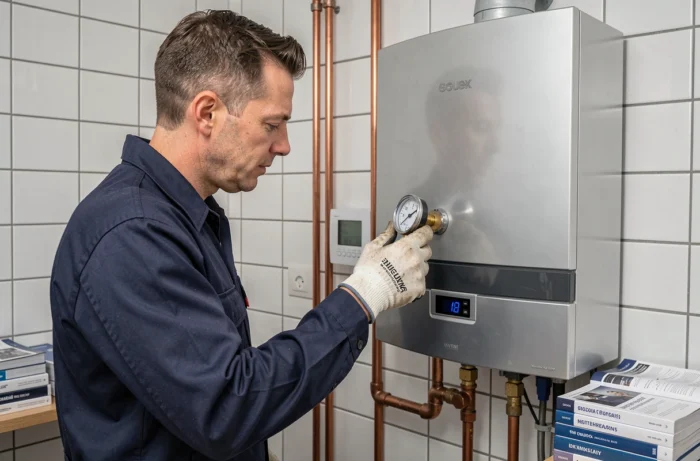
A Brussels homeowner replacing their gas boiler in 2025 does not face a ban. They face a timeline that makes this choice less and less profitable with each passing year. The question has changed in nature: we are no longer talking about legality, but about economic and regulatory relevance over the next fifteen years.
Gas boiler in Brussels in 2025: what the regulations still allow
In an existing building, installing a new gas condensing boiler remains legal in the Brussels-Capital Region. The nuance lies in the type of project. For new constructions, renewable heating has been mandatory since January 2025. Major renovations will follow the same path starting in January 2030.
Specifically, if an aging boiler is replaced in an existing apartment or house, gas is still acceptable. When we question the future of gas heating in Brussels, the answer mainly depends on the time horizon we set.
Another often-overlooked constraint: since January 1, 2025, owners of a gas atmospheric boiler or water heater connected to a collective chimney must have a feasibility report for the replacement of this device. Atmospheric boilers are under scrutiny, not just oil.
Oil boilers, on the other hand, can no longer be installed since June 1, 2025, unless an exemption is granted. The average age of these devices exceeds 25 years in Brussels, meaning that the wave of forced replacements is already underway.

PEB certificate and sanctions 2033: the real lever affecting gas
The regulations on heating devices are just one part of the system. The PEB certificate (energy performance of buildings) imposes a gradual renovation trajectory. The Region aims for an average residential stock equivalent to label C by 2050, with intermediate milestones.
Starting in 2033, automatic sanctions are planned for underperforming housing. An owner who keeps a gas boiler in a poorly insulated building risks being doubly penalized: by high consumption and by non-compliance with the PEB.
This is where the calculation changes. Keeping gas in a well-insulated home, with a recent condensing boiler, remains justifiable in the short term. Keeping gas in a thermal sieve means accumulating two debts in parallel: that of insulation and that of the future replacement of the device.
What the PEB label changes for resale
A property rated F or G with an aging gas boiler will sell more difficultly. Buyers now factor in the cost of compliance in their offers. The heating system directly impacts the property’s value, not just the monthly bill.
Heat networks and decarbonization by neighborhood: the alternative that Brussels is structuring
Brussels is not just restricting gas. The Region is developing a neighborhood-scale planning approach, combining several solutions: heat networks, geothermal energy, ambient or river heat, heat pumps, biomass, and biogas.
Thermal energy networks are gaining importance. The Brussels regulator BRUGEL has launched consultations on their deployment. For a co-owner in the city center, the question is no longer just “heat pump or gas boiler,” but also “will my neighborhood be connected to a heat network in the next ten years?”
Decarbonization is now taking place at the neighborhood level, not just in each isolated home. A building located on the route of a future thermal network does not have the same interest in investing in an individual heat pump as a house on the outskirts.
Heat pump or hybrid system: decide based on the building
For well-insulated buildings, the air-to-water heat pump covers most needs, even at low temperatures. For older buildings with high-temperature radiators, opinions vary on this point: a hybrid solution (heat pump combined with a gas condensing boiler) can cover cold peaks without oversizing the installation.
- Isolated housing, low-temperature radiators: heat pump alone, often the best annual efficiency.
- Older building, high-temperature radiators, no outdoor space: hybrid system as a transition, awaiting a deeper renovation or network connection.
- Co-ownership on an identified heat network route: delay individual investment and inquire with the municipality or BRUGEL.
Cost of gas in 2025: the taxation that shifts the calculation
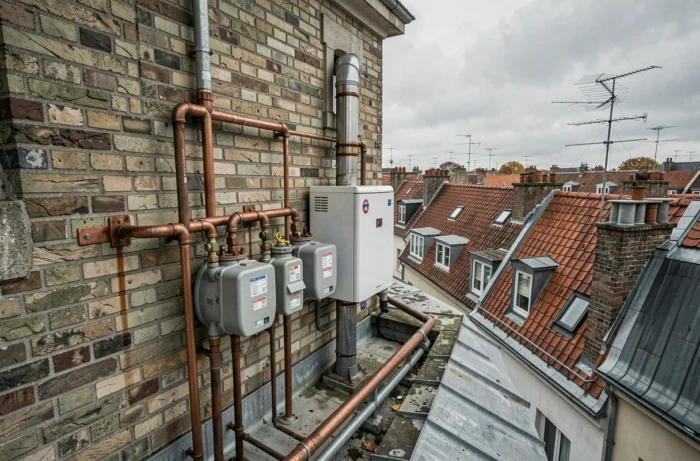
The price of natural gas is no longer as advantageous as it once was. Taxation is gradually shifting: electricity is becoming relatively less taxed, while fossil fuels bear increasing charges. This trend, already visible in 2025, is expected to intensify with upcoming Belgian and European tax revisions.
For a Brussels household, this means that the operating cost of a gas boiler is increasing even if the price of raw gas remains stable. The Renolution grants, accessible through Brussels Environment, cover part of the investment in a heat pump or renewable system, reducing the initial cost gap.
- Check eligibility for Renolution grants before any boiler replacement.
- Compare the total cost over ten years (installation, consumption, maintenance, PEB compliance) and not just the purchase price.
- Request a sizing note from a professional to calculate the actual thermal needs of the home before choosing a system.
Insulate before choosing a device
One point that all serious installers emphasize: the insulation of the home determines the choice of heating, not the other way around. Investing in a high-performance heat pump without addressing the walls or windows means oversizing a device to compensate for avoidable losses.
Gas heating in Brussels will not disappear overnight. It remains a legal option in existing buildings, sometimes relevant as a hybrid solution for buildings that are difficult to renovate quickly. What is changing is that each year brings homeowners closer to a threshold where keeping gas costs more than transitioning.
The milestones of 2030 and 2033 are not distant hypotheses. They are budget deadlines to be integrated now into any renovation or replacement project.