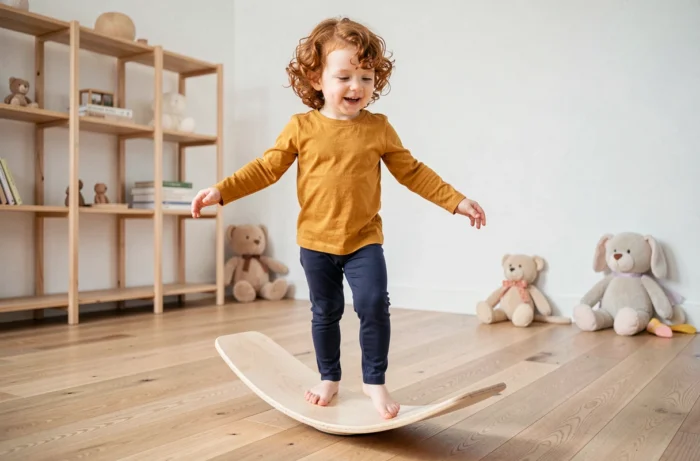
The Wobbel board is based on a simple biomechanical principle: a curved wooden surface that generates controlled instability. This instability constantly engages the child’s vestibular system and postural muscle chains. We observe that most articles on the subject limit themselves to general benefits, without addressing the proprioceptive mechanisms or material criteria that make a difference in use.
Vestibular Stimulation and Proprioception on the Wobbel Board
The vestibular system, located in the inner ear, processes information related to head position and body accelerations. In children, this system only reaches full maturity after several years of regular stimulation. A curved board like the Wobbel imposes constant micro-postural adjustments that activate the semicircular canals and otoliths.
This work is not limited to “standing still.” In standing, kneeling, or lying on the stomach, the child recruits distinct sensorimotor loops. Each posture on the board activates different proprioceptive patterns, enriching the internal body map much more than a simple static balance exercise on a flat surface.
Pediatric physiotherapists have long used Freeman boards for proprioceptive rehabilitation. The Wobbel stands out for its longitudinal curvature, which allows for a forward and backward rocking motion. This tilting movement engages the stabilizing muscles of the ankle, pelvis, and trunk in a sagittal plane, whereas a round board works more in rotation.
To learn everything about the Wobbel board and its various versions, we recommend comparing the curves and dimensions before any purchase, as these parameters directly condition the amplitude of rocking and thus the intensity of vestibular work.
European Beech Wood and Manufacturing: What Determines Durability
The material composition of a balance board conditions both its longevity and the sensory feedback it provides. The Wobbel is made from several layers of FSC-certified European beech wood, stacked and then bent under high pressure. This layering process gives the board calibrated flexibility while ensuring high mechanical resistance.
Beech offers a tight grain and a natural density superior to that of pine or birch. In practice, this translates to a surface that does not easily mark under repeated impacts and ages without splintering. The brand positions its products as durable toys, designed to last through several generations of users within the same family.
Coating and Grip: Felt, Cork, or Raw Wood
Depending on the models, the underside may be equipped with pressed wool felt or a cork coating. This choice is not cosmetic:
- The felt dampens the rocking noise on hardwood floors and protects delicate surfaces, while slightly cushioning the rebound curve.
- The cork offers superior grip on tiles and reduces lateral slipping, which is better suited for children in the learning phase.
- Raw wood, without coating, maximizes the board’s responsiveness and provides more direct sensory feedback, suitable for users who already have good balance.
The choice of coating directly modifies the biomechanical behavior of the board. We recommend felt for versatile indoor use and cork for younger children.
Free Play and Sensory Stimulation: Beyond Balance
Reducing the Wobbel to a balance tool overlooks its main interest in an educational context. The brand explicitly communicates the concept of open-ended play, meaning a support without a predefined function that the child repurposes according to their imagination.
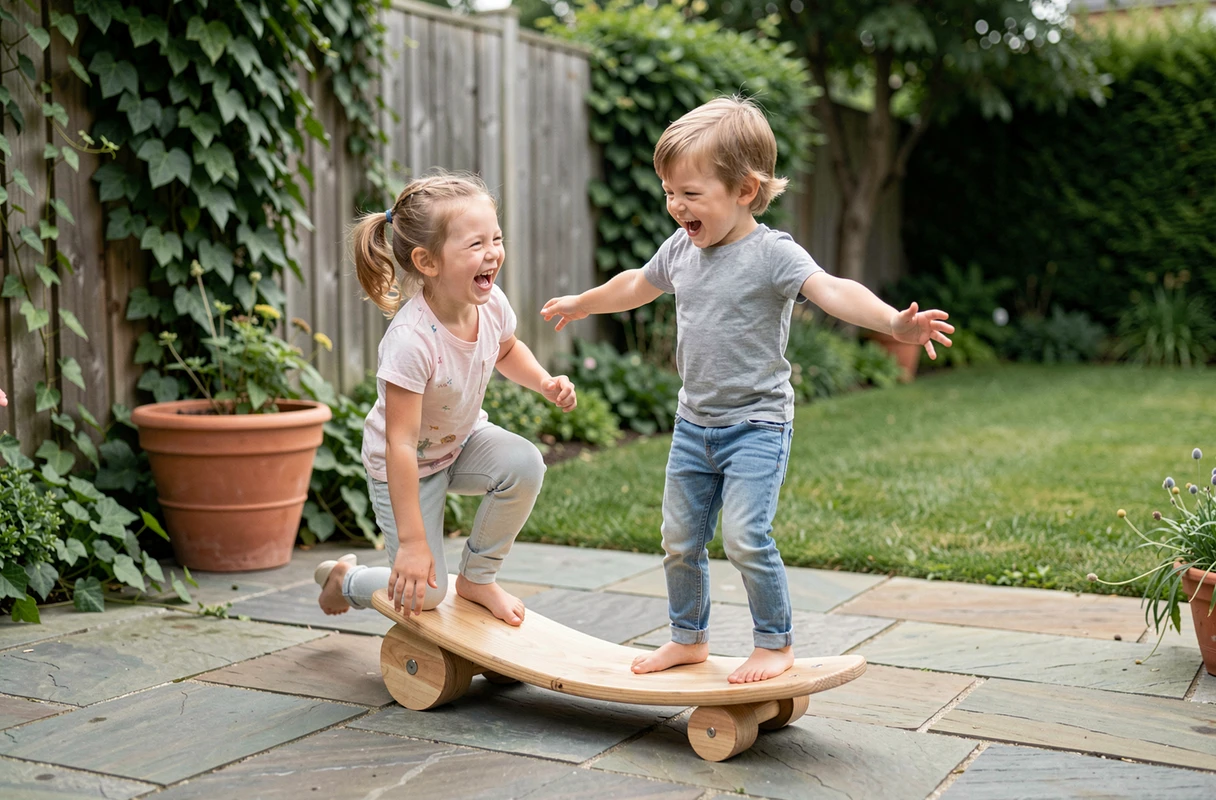
A three-year-old transforms the board into a bridge for their figurines. A six-year-old uses it as a slide for marbles. A nine-year-old employs it as a launch ramp for wooden constructions. This versatility is not anecdotal: it activates cognitive skills of planning, problem-solving, and divergent thinking that single-function toys do not engage.
Concentration and Perseverance through Multisensory Stimulation
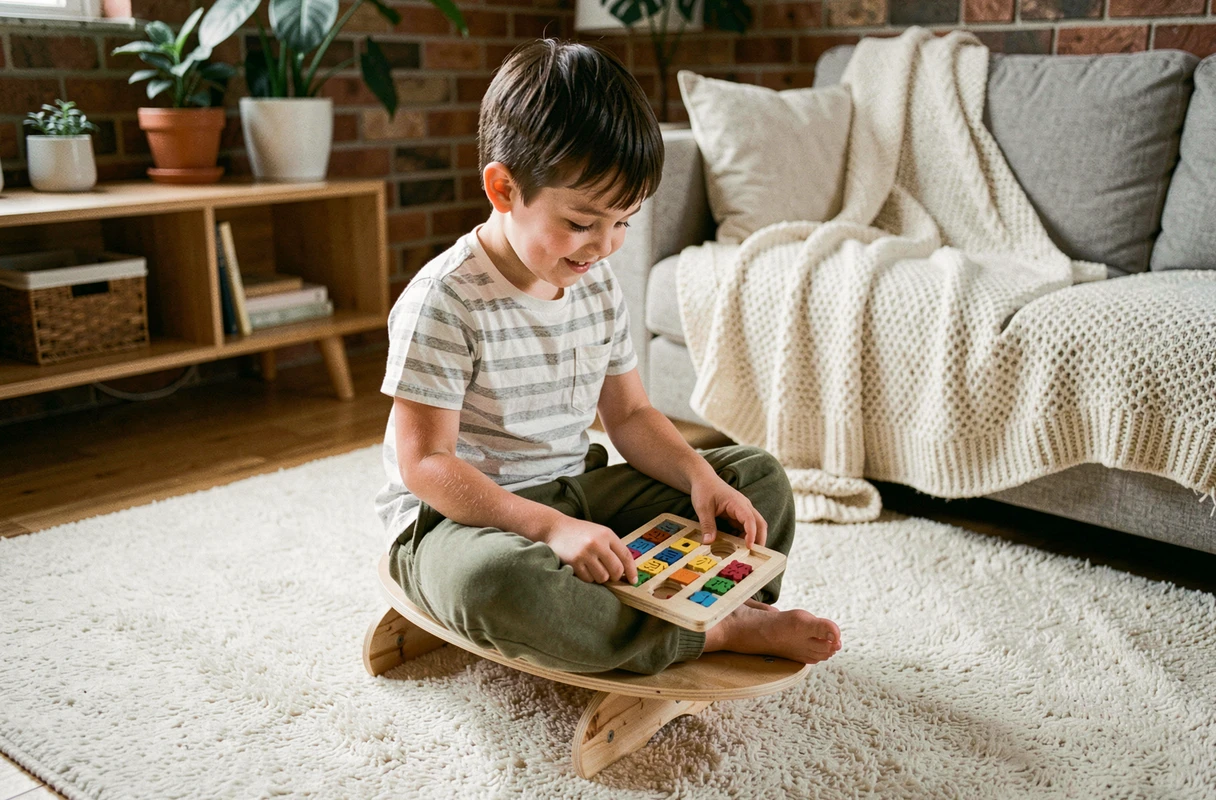
Complementary accessories (textured balls, sensory cushions) added to the board allow for a combination of balance work and tactile exploration. The child who tries to remain stable while manipulating an object on the curved surface simultaneously engages their vestibular system, eye-hand coordination, and working memory.
This multisensory engagement develops sustained attention capacity. In Montessori pedagogy, this type of activity corresponds to the principle of “deep concentration”: the child freely chooses their activity, repeats it, and gradually builds their ability to maintain attention on a complex task.
Wobbel Board for Adults: An Often Underestimated Intergenerational Use
The Wobbel supports loads significantly greater than a child’s weight. This makes it a functional tool for adults seeking postural strengthening, stretching, or gentle rehabilitation. Several models accommodate users of all sizes, transforming the board into a shared family equipment.
For an adult, slow rocking on the Wobbel engages the deep transverse and spinal erector muscles. This dynamic stabilization work effectively complements a classic strengthening routine. Teenagers who practice surfing or skateboarding find it a relevant proprioceptive training tool for transferring support.
The intergenerational aspect is not a hollow marketing argument. An object that the whole family uses remains visible, accessible, and integrates into daily routines, whereas a toy reserved for children often ends up stored in a closet after a few weeks.
The Wobbel board stands out from generic balance boards due to the quality of its beech layering, the diversity of its coatings, and its open-ended positioning. The most underestimated selection criterion remains the underside coating, which determines both acoustic comfort, grip, and proprioceptive feedback. Before purchasing, identify the dominant type of flooring in your home and the age of the primary user: these two parameters are enough to guide you to the right model.