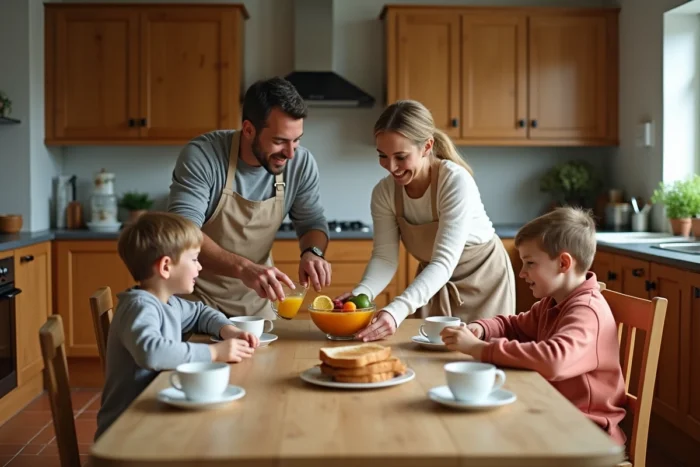
A child who refuses to get dressed at 7:45 AM, a meal that turns into a tug-of-war over vegetables, a couple that only communicates in logistical terms. A thriving family life is not decreed; it is built on concrete, often tiny adjustments. A few practical levers can change the dynamics of daily life without requiring a complete reinvention.
Morning Family Routine: Diffusing Tensions Before 8 AM
We underestimate how much the first thirty minutes after waking up shape the rest of the day. When every morning starts with reminders to behave, tensions rise, and everyone leaves frustrated.
A tip that works: prepare the night before everything that generates stress in the morning. Clothes laid out, backpacks packed, semi-prepared breakfast. This frees up mental space for a calm exchange around the table, even if brief.
Feedback on this point varies depending on the children’s ages, but setting up a visual sequence (poster, magnetic board) helps younger ones follow the steps without needing to repeat instructions. The goal is not perfection; it is to reduce the number of verbal instructions before leaving.
There are also resources dedicated to family on the Affaires du Jour website, which addresses these organizational and parenting issues from a practical angle.
Positive Micro-Habits: Strengthening the Parent-Child Bond
A study published in 2023 in The Journal of Positive Psychology, conducted with 300 families in six countries, shows that very small daily habits (explicit gratitude, sharing pleasant moments) are associated with a significant increase in perceived family well-being and marital satisfaction.
In practice, we are not talking about time-consuming grand rituals. We are talking about actions that take two minutes:
- At dinner, everyone shares a pleasant moment from their day, including the adults. Children quickly get the hang of it and start to identify positive moments themselves.
- Before bed, a time for physical contact (hug, back massage, shared reading) without screens or distractions. This moment works just as well at age 3 as at age 10.
- On weekends, an activity chosen in turn by each family member, even if the choice seems surprising. Letting a child decide reinforces their sense of autonomy.
These micro-habits require little effort but create an emotional regularity that children quickly identify as a reassuring anchor.
Decluttering and Family Minimalism: Fewer Objects, Fewer Disputes
In recent years, minimalism in families has gained ground in Francophone households. The principle is simple: voluntarily limit the number of objects and toys in the living space.
There is a direct effect on conflicts. Fewer scattered toys mean less tidying up to demand and fewer disputes between siblings over the ownership of certain objects. Parents who practice the “one item in, one item out” rule report a notable decrease in tensions around tidying up and an increased sense of calm in the home.
In concrete terms, we can start with a seasonal sorting with the children. We keep what is used, and we give away the rest. The idea is not to live in emptiness but to question together what truly brings satisfaction. This shared process also teaches younger ones to make choices and respect their space.
Couple Life After the Arrival of a Child: Protecting Time for Two
When a baby arrives, the couple often shifts into “crisis teammates” mode. We manage nights, bottles, logistics, and the romantic relationship takes a back seat without us realizing it.
The trap is to indefinitely postpone. A couple that only talks about logistics ends up feeling like roommates. We don’t need elaborate evenings to maintain the relationship. A coffee together during the little one’s nap, a twenty-minute conversation without phones after the kids are in bed, a message during the day that doesn’t concern groceries.
The reflex to adopt: block a recurring time slot, even a short one, dedicated to the couple. Not a “relationship discussion,” just a moment where we reconnect as two adults who appreciate each other. Regularity matters more than duration.
Children’s Emotions: Supporting Without Minimizing or Overreacting
In the face of anger or tears, the temptation is strong to cut it short (“it’s nothing,” “stop crying”) or, on the contrary, to let oneself be overwhelmed by the child’s distress. Neither of these reactions helps them progress.
Naming the emotion out loud remains the most effective technique: “You are angry because your brother took your toy.” The child feels understood, which reduces the intensity of the crisis. We can then offer an alternative or a solution, but only after this validation step.
This reflex also works between adults. When a partner expresses frustration after a difficult day, rephrasing before suggesting solutions avoids many misunderstandings. Positive parenting is not reserved for children; it permeates all family relationships.
Building a thriving family life relies less on grand principles than on the consistency of small gestures. A calm morning routine, a few rituals of gratitude, a decluttered living space, protected time for the couple, and active listening to emotions form a solid foundation. What makes the difference is repetition, not the magnitude of the effort.