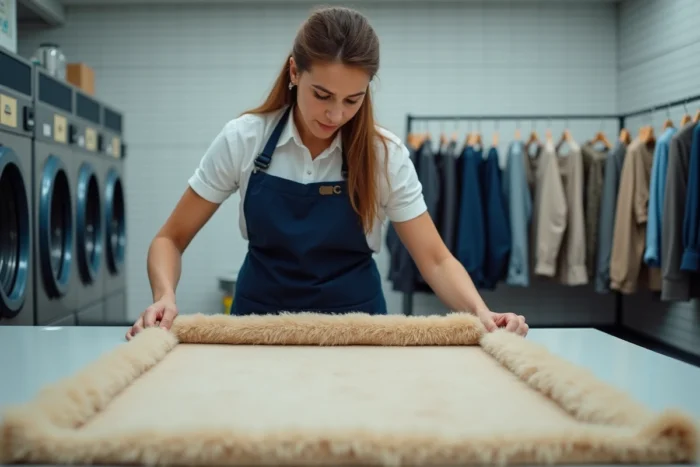
The cleaning of a carpet at a dry cleaner is based on a simple principle: entrust the fiber to a third party who assumes responsibility for the result. Home washing, on the other hand, transfers this responsibility to the individual, with a variable material budget and a risk proportional to the lack of knowledge about the textile. Comparing the two options requires going beyond just the price list to examine what each solution protects or exposes.
Responsibility and Compensation: What the Dry Cleaner Guarantees and What Home Washing Does Not
Before comparing prices, it is essential to understand what happens when a cleaning goes wrong. At a professional establishment like 5 à sec, the dry cleaner is presumed responsible for any deterioration unless there is a pre-existing defect or customer fault. The National Institute of Consumption reminds us of this principle and specifies the compensation scales commonly applied.
At 5 à sec, compensation is calculated based on the purchase value listed on the customer’s invoice, with a deduction based on age: 80% for an item less than three months old, 60% before thirty months, and 30% beyond that. Without an invoice, the scale of the French Federation of Dry Cleaners and Laundries serves as a reference.
At home, no safety net of this kind exists. An excess of water on a jute carpet, an overly aggressive product on a knotted wool, and the loss is absolute. This compensation framework constitutes a form of insurance integrated into the dry cleaning price, a factor that price comparisons almost systematically overlook. When evaluating the price of carpet cleaning at 5 à sec, this guarantee is part of the actual cost.
Price Transparency in Dry Cleaning: A Recent Regulatory Requirement

Dry cleaners, including brands like 5 à sec, are now subject to a strengthened obligation of price transparency. The decree of March 18, 2015, mandates clear and visible price displays, whether in the window or at the reception, for each type of item handled.
This regulation also governs additional charges. A stain treatment, specific drying, or the handling of a large carpet must be included in the estimate or the displayed price list. The customer knows before dropping off their carpet how much the service will cost, with no surprises upon return.
At home, the budget is anything but transparent. The actual cost of home washing is diluted among the cleaning product, any rental of a carpet cleaner, the water used, and the time spent. No one totals these items, creating the illusion of a free or nearly free cleaning.
Home Washing: Methods, Limits, and Concrete Risks to Fibers
Home cleaning encompasses very different techniques depending on the equipment used. Each acts on the fibers in a specific way, with varying margins of error.
- Carpet cleaner or injector-extractor: sprays water mixed with detergent into the carpet, then sucks up the dirty liquid. Effective on synthetic fibers, but insufficient drying can cause mold and odors, especially on thick wool or cotton carpets.
- Dry foam cleaning: applied with a broom or brush, the foam encapsulates dirt without saturating the carpet with water. Suitable for sensitive natural fibers, but limited on deep or old stains.
- Pressure washer: sometimes used outdoors on robust carpets (polypropylene, entrance mats), it effectively removes ingrained dirt. On a delicate carpet, the pressure destroys the fiber structure and detaches the glued weaves.
- Steam: high temperature disinfects and degreases, but the residual moisture remains the critical point if the carpet does not dry quickly in a ventilated space.
The main problem with home washing lies less in the method than in identifying the textile. A jute carpet can hardly withstand prolonged contact with water. A synthetic carpet is much more forgiving. Without knowing how to read the composition or recognize the type of fiber, the individual chooses their method at random.
Dry Cleaning or Home: The Decision Depends on the Carpet, Not the Budget
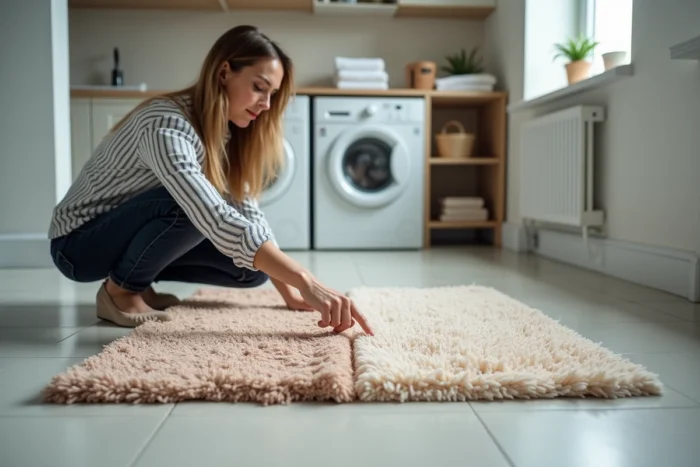
The reflex is to choose the cheapest option. This is a framing error. The value of the carpet determines the relevant cleaning method, not the other way around.
An entrance carpet made of synthetic fibers purchased for a few dozen euros does not justify a drop-off at the dry cleaner. A pass with the carpet cleaner or dry foam cleaning is sufficient, and the risk of loss is negligible. In contrast, a hand-knotted carpet, an antique kilim, or a silk model represents an investment where even the slightest damage costs much more than dry cleaning.
For carpets of intermediate value (machine-woven wool, thick cotton), the question becomes significant. Dry cleaning offers consistent results and assumes the risk. Home washing allows for more frequent maintenance at a lower cost, provided two parameters are mastered: the type of fiber and drying.
- Common synthetic carpet: home washing with a carpet cleaner, regular maintenance with a broom or vacuum, dry cleaning unnecessary unless there is a stubborn stain.
- Mid-range wool or cotton carpet: dry foam or light steam at home for regular maintenance, dry cleaning once or twice a year for deep cleaning.
- Antique, hand-knotted, or fragile fiber carpet: systematic dry cleaning for any cleaning beyond simple dusting.
Drying remains the most underestimated factor in home washing. A poorly dried carpet develops mold in a few days, emits a persistent odor, and may lose its shape. In dry cleaning, controlled drying is part of the standard process.
The choice between dry cleaning and home washing is not a budgetary arbitration. It is a matter of risk management relative to the value of what is being cleaned. A carpet with high sentimental or financial value deserves the guarantee of a professional. For the rest, well-executed home maintenance, with the right method and complete drying, yields perfectly acceptable results.