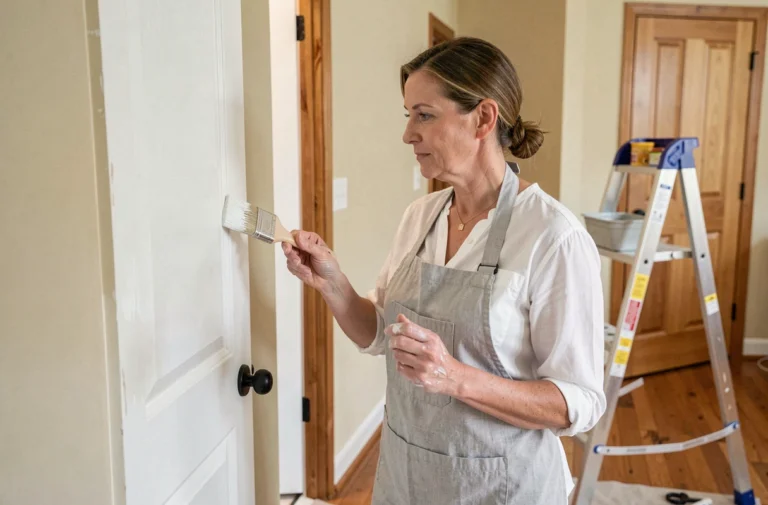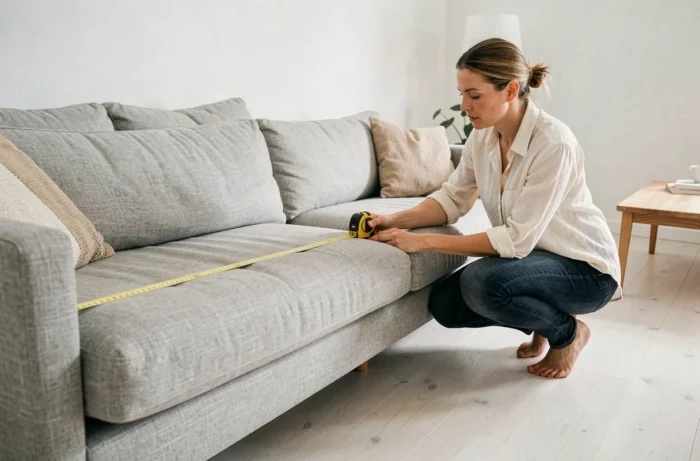
Choosing a sofa without knowing the dimensions of your living room is like buying shoes without trying on the size. Total width, seat depth, backrest height: these three measurements determine both daily comfort and the flow of movement in the room. Before comparing models, you need to know what you are measuring, what you are comparing, and where the differences lie that make the distinction between a suitable sofa and a cumbersome piece of furniture.
Circulation constraints and PMR standards: the forgotten parameter
Most sizing guides reason in terms of the gross area of the living room. They overlook a factor that mechanically reduces usable space: accessibility requirements in new housing.
The ELAN law mandates that at least 20% of new collective housing must be accessible for people with reduced mobility (PMR) upon delivery. In these apartments, a turning area of 1.50 m in diameter must remain clear in the living space to allow for the maneuvering of a wheelchair.
In practical terms, in a medium-sized living room, this turning area absorbs a significant portion of the floor space. A deep corner sofa can then render the room non-compliant. Even outside of PMR contexts, maintaining a passage of at least 70 to 90 cm around the sofa remains the standard for smooth circulation.
Before making any decisions, it is essential to map out the passage areas, doors, radiators, and outlets, then mark on the floor (with tape) the maximum footprint of the future sofa. This measurement takes ten minutes and avoids a costly return.
To deepen this preparatory work, the dimensions of a sofa according to La Maison Durable detail the standard measurements by number of seats and configuration.
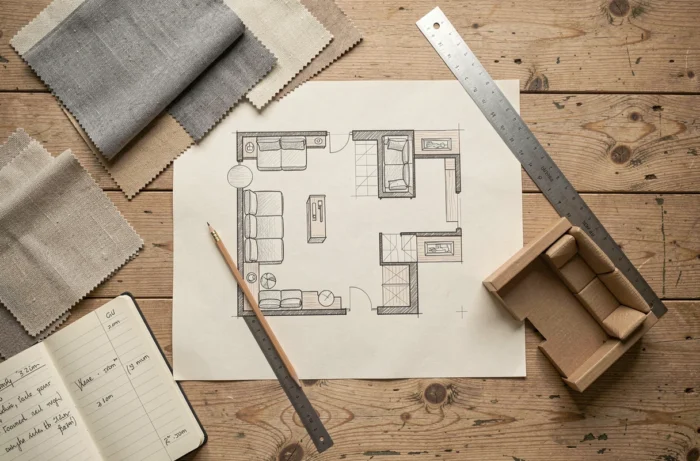
Comparison table of standard dimensions by type of sofa
Dimensions vary significantly depending on the shape of the sofa. The table below summarizes the usual ranges for the most common configurations.
| Type of sofa | Indicative total width | Indicative total depth | Indicative seat depth |
|---|---|---|---|
| 2 seats | 140 to 170 cm | 80 to 95 cm | 50 to 55 cm |
| 3 seats | 180 to 240 cm | 80 to 95 cm | 50 to 60 cm |
| Corner | 250 to 300+ cm (long side) | 150 to 200 cm (return) | 50 to 60 cm |
| Modular | Variable (modules from 60 to 90 cm) | Variable | 50 to 65 cm |
The difference between a compact 2-seater and a generous corner sofa can exceed a meter in width. It is this difference that determines whether the sofa frees up or saturates the circulation space.
What seat depth reveals
Seat depth matters more than total width for comfort. Between 50 and 55 cm, the seat is suitable for an upright posture and for average-height individuals. Beyond 58 cm, one shifts to a “lounge” seat where you sink in, pleasant for watching a movie but less suitable for reading or working on a laptop.
On the other hand, total depth (seat + backrest + rear structure) directly impacts the space needed between the sofa and the wall or opposite furniture. A sofa with a total depth of 95 cm placed facing a TV unit requires a living room of at least 3.50 m in that direction to maintain a proper passage.
Modular sofa or fixed sofa: when dimensions become variable
Recent trends show a clear increase in modular sofas, especially for small spaces. The principle: independent modules (seats, corners, chaise longues) that can be assembled or separated according to needs.
- A single module generally measures between 60 and 90 cm wide, allowing for easy passage through doors and staircases, a common issue with monobloc corner sofas.
- The configuration can evolve: two modules in a line for daily use, three modules in an L-shape for hosting guests, a standalone module moved to another room.
- The modular option solves the problem of fixed dimensions, but requires checking that each module has a reliable attachment system to prevent slipping.
The fixed sofa, on the other hand, generally offers a more uniform seating experience (no junction between modules) and often a lower price per linear meter. For a living room whose configuration will not change, the fixed option remains the simplest choice.
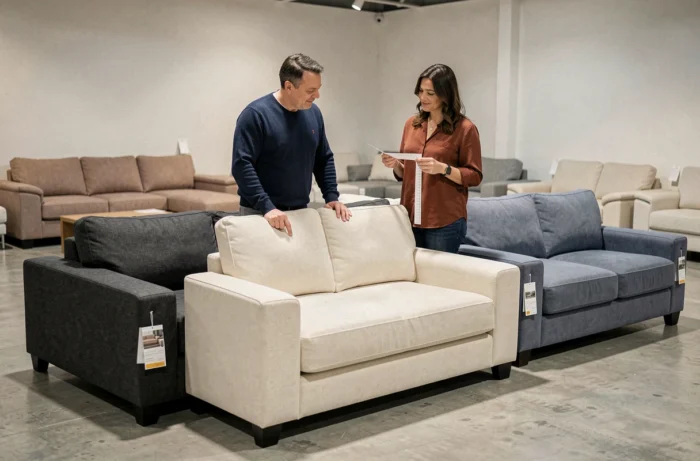
Depth, seat height, and user size: the dimensions to cross-reference
A sofa is also chosen based on the people who will sit on it. Seat height, often overlooked, plays a direct role in joint comfort.
A low seat height (less than 40 cm) complicates getting up for elderly or mobility-impaired individuals. Conversely, a high seat (45 cm and above) is better suited for taller individuals and facilitates the transition from sitting to standing.
The width per seat also deserves attention. On average, 70 to 80 cm per person is counted for adequate comfort. A 3-seater sofa of 180 cm thus offers 60 cm per person, which is tight if three adults sit down simultaneously. At 210 cm, the ratio increases to 70 cm, significantly more comfortable.
Convertible sofa: additional dimensions to check
If the sofa also serves as an extra bed, two dimensions are added to the equation: the size of the unfolded bed and the space needed in front of the sofa to open the mechanism.
- A compact convertible often offers a sleeping area of 120 to 140 cm wide, sufficient for one person.
- A 3-seater convertible can reach 140 to 160 cm of sleeping width, corresponding to a narrow double bed.
- Plan for at least 2 meters of clearance in front of the sofa to unfold the mechanism without having to move the coffee table each time.
This clearance is often underestimated. In a small living room, it can make the convertible impractical for daily use, even when the closed dimensions of the sofa seem compatible with the room.
The sizing of a sofa hinges on three cross-referenced measurements: the footprint relative to circulation areas, the seat depth relative to the dominant use, and the seat height relative to the size of the users. Taking these measurements before visiting a showroom transforms an emotional purchase into a measured decision.